

The machine you buy will define your studio’s client experience, your session workflow, and your ability to compete for bookings in your market. The HD Live vs 4D ultrasound decision is one of the most consequential equipment choices a studio owner makes — and most people approach it with the wrong frame entirely.
The wrong frame is asking which technology is “better.” The right frame is asking which technology is better for your specific studio goals, client expectations, service menu, and budget. These are genuinely different imaging technologies with different visual outputs, different use cases, and different price points. Understanding what each actually delivers — from a studio operator’s perspective, not a consumer’s — is how you make the right call.
At Ultrasound Trainers, we work with studio owners evaluating equipment across a range of budgets and business models. The HD Live vs 4D question comes up in almost every equipment conversation. Here is what we have learned about how operators should be thinking through this decision.
What 4D Ultrasound Actually Delivers in a Studio Environment
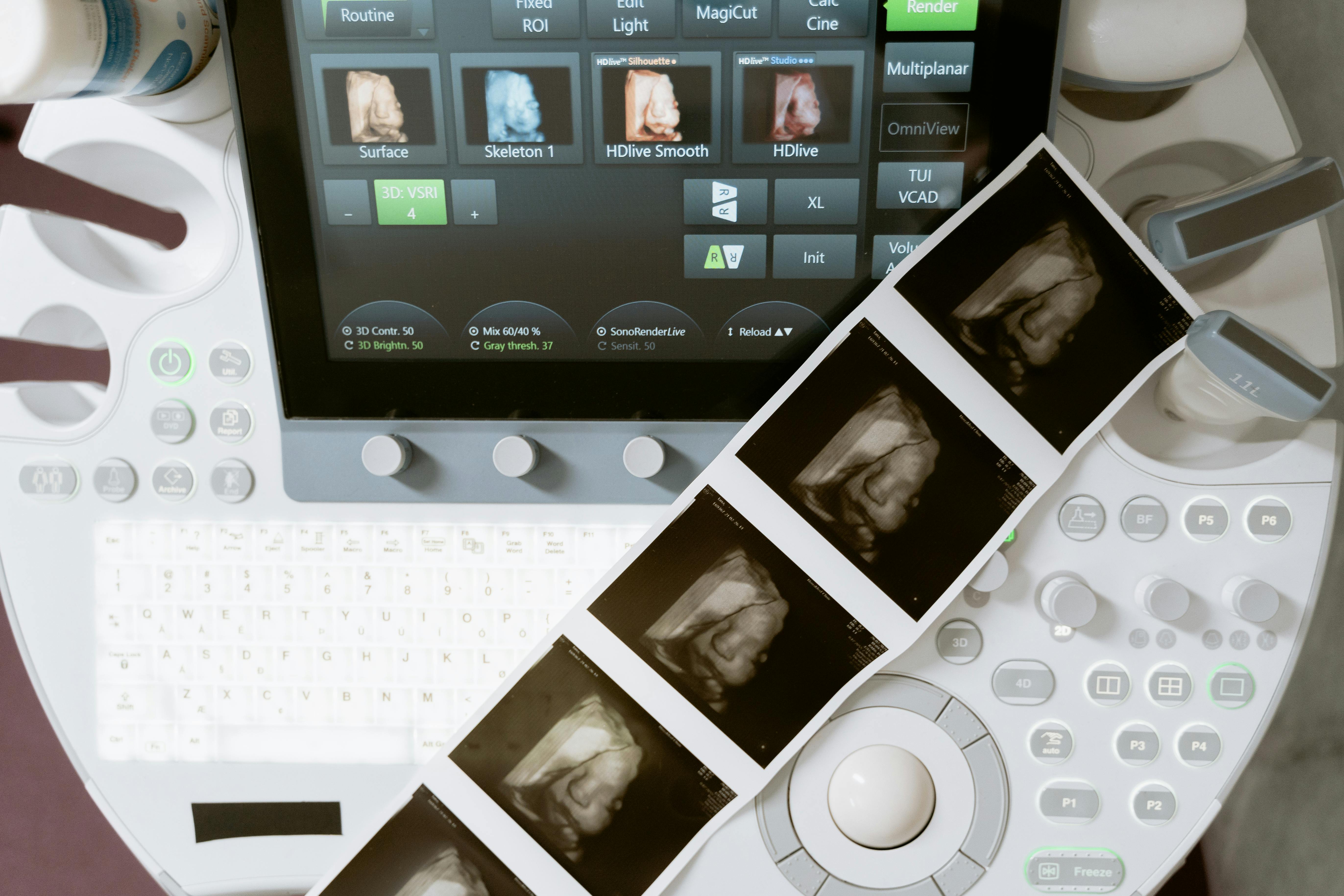
Standard 4D ultrasound produces real-time three-dimensional imaging with a time dimension — meaning you see the baby moving in three-dimensional space rather than a static image. The output is a live-action view of the fetus in amber-toned rendering, showing facial features, limb movements, and general position in real time.
For a studio context, 4D imaging is well-established and widely recognized by clients. Most families searching for a “3D/4D ultrasound studio” have seen social media posts and photos from this kind of imaging. The expectation is set before they book. 4D machines at appropriate quality tiers deliver consistently compelling results that satisfy client expectations and produce the kinds of images families want to share.
The practical advantages for studio operators are meaningful. 4D capable machines at the mid-range quality tier are more accessible in price than top-tier HD Live systems. They are also widely available, with established support ecosystems, parts availability, and training resources built around them. For a studio opening in a mid-size or smaller market, a well-maintained 4D machine can deliver an excellent client experience without the capital outlay of premium HD Live technology.
What HD Live Technology Actually Delivers
HD Live is a rendering technology developed by GE Healthcare and now used across several manufacturers under various brand names. The core difference from standard 4D rendering is the lighting simulation: HD Live applies a virtual light source that creates depth, shadow, and surface texture on fetal images in a way that makes them look dramatically more photorealistic.
The visual result is images that look less like the amber sepia tones of traditional 4D and more like a rendered photograph. Skin texture, shadow depth, facial contour — the level of detail that HD Live-capable machines at the top tier can produce is genuinely striking. For studios competing on image quality in affluent markets, or positioning themselves as a premium experience at the high end of local pricing, HD Live imaging provides a visual differentiation that clients notice and share.
The practical considerations are equally real. HD Live machines at the quality tier that produces the most impressive results carry significantly higher price tags than mid-range 4D systems. They also tend to require more from the operator — the imaging settings that optimize HD Live output are more nuanced, and the investment in learning to use the technology well is greater. HD Live imaging at below-optimal settings does not automatically outperform a well-operated 4D system.
| Feature | Standard 4D | HD Live |
| Image Rendering | Amber-toned 3D rendering | Photorealistic with light simulation |
| Real-Time Motion | Yes | Yes (on HD Live capable machines) |
| Entry Price Point | More accessible at mid-range tier | Higher — premium systems required |
| Client Recognition | Widely recognized and expected | Increasingly valued as differentiator |
| Operator Learning Curve | Manageable with proper training | Steeper — optimization is more nuanced |
| Best For | Most studio models and markets | Premium positioning, competitive urban markets |
Who This Decision Really Comes Down To
The operator who should lean toward a quality 4D system is someone opening in a market where elective ultrasound is not yet well established, where the local price ceiling for sessions sits at a moderate level, or where startup capital needs to be managed carefully. A well-chosen 4D machine from a reputable brand — supported by proper training — will produce results that satisfy the vast majority of clients and hold up competitively in most local markets.
The operator who should lean toward HD Live capability is someone entering a market with established competition and a client base that has already been exposed to high-end elective imaging. If premium positioning at the top of local pricing is your business model — and you have the capital and the commitment to training that premium systems require — HD Live technology gives you a visual product that is harder for competitors working with older or lower-tier equipment to match.
Neither choice is universally correct. The studios we see struggle most are the ones that bought a technology tier without honestly assessing their market, their pricing ceiling, and their ability to invest in the training that makes expensive equipment perform at its potential.
The Questions That Should Drive Your Decision
Before you land on either direction, work through these honestly:
What is your local competition doing? If there are established studios in your market using premium HD Live systems and charging accordingly, entering with mid-range 4D technology means competing on something other than image quality — service experience, price, availability, or niche positioning. That can work, but it needs to be a deliberate strategy.
What is your realistic startup budget for equipment? Equipment is only one component of your startup investment. Training, studio setup, branding, and marketing all have costs. Overallocating to equipment at the expense of these other essentials creates a different set of problems. Know your total budget and allocate it in proportion to what drives bookings, not just what impresses on a spec sheet.
What does your market’s pricing ceiling look like? A market where premium sessions command top-tier pricing can support a higher equipment investment with a clearer path to return. A market where sessions are priced at the lower to mid range makes a very expensive machine harder to justify on ROI grounds alone.
How committed are you to investing in operator training? This one matters more than most people expect. Expensive equipment underperforms in the hands of an undertrained operator. If you are not willing to invest in serious training alongside your machine purchase, the marginal gain from choosing HD Live over a quality 4D system will be limited.
How Ultrasound Trainers Approaches Equipment Guidance
We sell ultrasound equipment and help clients evaluate options based on their specific business model, market, and goals. We do not recommend one technology tier categorically over another, because the right answer genuinely depends on the situation. What we do is help operators ask the right questions before they commit to a purchase they will be working with for years.
When equipment selection is paired with proper training — understanding how to optimize your specific machine, how to get the best imaging output at your price tier, and how to present that output to clients effectively — the gap between technology tiers matters less than it might appear from a spec sheet alone. You can explore our elective ultrasound machine options and reach out to discuss what makes sense for your situation.
People Also Ask
Is HD Live ultrasound significantly better than 4D for client satisfaction?
The honest answer is: it depends on the quality tier and the operator. HD Live technology at its best produces images that are visually more photorealistic than standard 4D rendering. But client satisfaction correlates heavily with operator skill and the overall session experience, not machine technology alone. A skilled operator on a well-maintained 4D system will often outperform a less experienced operator on HD Live equipment in terms of actual client experience.
Can a studio compete effectively using standard 4D technology?
Absolutely. Many studios across the country operate successfully with quality 4D systems and deliver sessions that satisfy clients and generate strong word-of-mouth. Competition depends on your total studio experience — image quality, service warmth, booking ease, pricing, and marketing — not technology tier alone. In markets without established competition, a quality 4D system is entirely sufficient to build a strong local business.
What brands offer HD Live imaging for elective studio use?
HD Live is a GE Healthcare technology, but similar advanced rendering technologies exist across other major manufacturers. The specific branding varies by manufacturer. When evaluating machines for a studio purchase, it is worth asking specifically about the rendering technology and requesting sample imaging from a qualified demonstrator rather than relying on marketing materials alone.
How much more does HD Live capable equipment typically cost than standard 4D?
The price differential varies significantly depending on machine brand, model, age, and configuration. HD Live capable systems at the quality tier that produces the most compelling imaging tend to carry meaningfully higher price tags than mid-range 4D machines. For a startup studio, this difference needs to be evaluated in the context of total startup budget, not as a standalone equipment decision.
Should a first-time studio owner prioritize HD Live technology?
Not necessarily. For a first studio, the most important equipment decision is choosing a machine that produces reliably good imaging at your budget tier, is well-supported, and that you will receive proper training on. Starting with quality 4D technology and upgrading as revenue and market position develop is a sound approach many successful operators have taken.
Does the choice between HD Live and 4D affect training requirements?
Yes, in practical terms. HD Live optimization requires more nuanced understanding of machine settings and rendering parameters. Training that covers your specific machine and its technology is important regardless of which direction you choose, but the investment required to learn HD Live at its full potential is somewhat greater than for standard 4D operation.
About Ultrasound Trainers: Ultrasound Trainers provides elective ultrasound training, equipment sales, and turnkey business launch support for studio owners across the United States. We help operators evaluate equipment, build their training foundation, and launch studios that operate professionally from day one. Visit ultrasoundtrainers.com to learn more.
Last Updated: April 28, 2025
Get the Inside Track
Training tips, business advice, and exclusive deals delivered straight to your inbox.

How to Build a Pre-Launch Marketing Campaign for Your Elective Ultrasound Studio: A 60-Day Countdown Plan
Pre-launch marketing for an elective ultrasound studio begins 60 days before opening. This 60-day countdown[...]

What Career Changers in Hawaii Need to Know About Elective Ultrasound Training
Considering ultrasound training for a career change in Hawaii? This Q&A guide covers what training[...]

How to Find and Recruit Volunteer Scan Models for Elective Ultrasound Practice
Finding volunteer models for elective ultrasound practice is a skill in itself. Learn where to[...]

How to Write an Elective Ultrasound Business Plan That Actually Works
Writing an elective ultrasound business plan? This guide covers what to include, how to build[...]

How to Open an Elective Ultrasound Business in Honolulu: A Practical Startup Guide
Open an elective ultrasound business in Honolulu with confidence. This guide covers training, startup costs,[...]

Adding Elective Ultrasound to an Existing Photography or Doula Practice in Montana
Montana birth photographers and doulas: adding an elective ultrasound add-on business in Montana to your[...]

Starting an Elective Ultrasound Business in Cheyenne, Wyoming: First-Mover Advantage in the Least-Crowded Market in the Country
Thinking about starting an elective ultrasound business in Cheyenne, Wyoming? This guide covers the F.E.[...]

Elective Ultrasound Training for Career Changers in Sweden
Considering a career change into elective ultrasound in Sweden? Find out what training involves, whether[...]

What Career Changers in Fayetteville Should Know About Elective Ultrasound Training
Thinking about elective ultrasound training in Fayetteville, Arkansas as a career changer? This Q&A guide[...]

The Biggest Mistake Las Vegas Elective Ultrasound Studios Make With Their Marketing
Elective ultrasound studio marketing in Las Vegas prioritizes trust and reviews over ad spend. Here's[...]

Mobile Elective Ultrasound for Baby Shower Events: Packages, Pricing, and Logistics
Mobile ultrasound baby shower events guide for elective studio operators. Covers package structure, pricing frameworks,[...]
Birth Center and Midwife Referral Partnerships: Building a Consistent Lead Pipeline for Your Studio
A birth center referral partnership for an elective ultrasound studio builds a consistent, high-converting lead[...]
