

Picture this: you are three weeks from opening your elective ultrasound studio and the vendor just asked whether you want to add HD Live to your machine package. You have seen it mentioned online and in other studios’ marketing, but you are not entirely sure what is hd live ultrasound, what it actually costs to add, or whether it changes the client experience enough to justify the upgrade. It is a question that deserves a direct answer before you finalize the purchase.
HD Live is a rendering technology, not a separate machine or probe. Understanding exactly what it does, what it changes about the images you produce, and how clients respond to it gives you the information you need to make a confident decision.
HD Live ultrasound is a 3D rendering mode that adds simulated lighting and shadow effects to produce more photo-realistic fetal images. It is a software feature available on select premium ultrasound machines. For studios competing at the high end of the market, it can be a meaningful differentiator. For a new studio working within a tight budget, strong 4D imaging without HD Live still produces compelling results. Last Updated: May 2025
What HD Live Ultrasound Actually Is
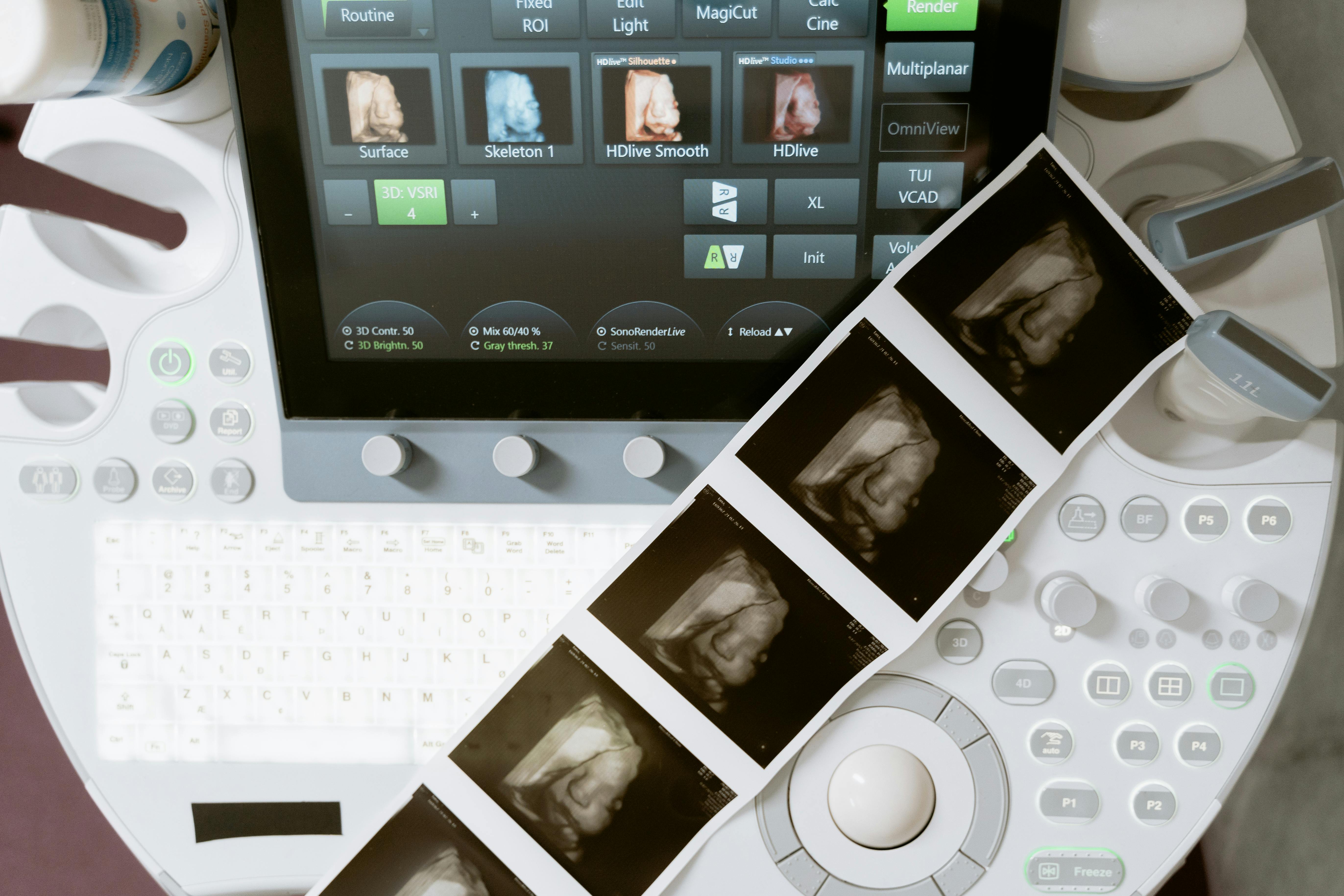
HD Live ultrasound is a three-dimensional rendering technology that applies a simulated, adjustable light source to a 3D fetal image, creating shadows and depth that make the image appear far more lifelike than standard 3D rendering. The result is an image that looks less like a traditional ultrasound scan and more like a softly lit photograph of a newborn. HD Live is primarily associated with GE Healthcare, where the feature is built into Voluson-series machines, though other manufacturers have developed comparable rendering modes under different brand names.
The technology does not change the underlying scan data. The same acoustic information captured by the probe is processed differently during rendering. Standard 4D ultrasound renders motion in real time with a fairly even surface illumination. HD Live adds a directional light source that the operator can rotate around the image, choosing the angle that produces the most detail and the most flattering presentation for the baby’s features.
According to the American Institute of Ultrasound in Medicine, advances in 3D rendering technologies have significantly expanded the range of clinical and elective applications for ultrasound imaging. For elective studios specifically, those rendering improvements translate directly into images that generate stronger emotional responses from families.
How HD Live Images Look Different From Standard 4D
Standard 4D imaging captures real-time movement and renders the baby’s surface with even coloring and good depth. For families watching a baby yawn, stretch, or roll in real time, the experience is already remarkable. The limitation of standard 4D is that still images captured from the session can look slightly flat or waxy, especially when printed or shared on social media.
HD Live changes that significantly. The adjustable light source creates shadows in the eye sockets, under the nose, along the curve of the cheek. Features that look blurred or indistinct in standard 3D rendering become sharply defined. Parents who receive HD Live still images often describe them as looking like newborn photography. The reaction is different in quality, not just degree.
That distinction matters for studio marketing. Studios that lead with HD Live imagery in their social media and on their website are presenting a visual standard that standard 4D images may not match. Families who have researched keepsake ultrasound before booking have often already seen HD Live imagery and come in expecting it.
Which Machines Include HD Live or a Comparable Feature
HD Live is natively available on GE Voluson series machines, most prominently the Voluson E10 and E8 lines. Samsung’s comparable technology is marketed as CrystalVue on the HERA W10 and related systems. Other manufacturers have developed their own versions under different names. The key point is that HD Live or equivalent rendering is not universally available on every 4D machine at every price tier. It is primarily a feature of premium or upper-mid-tier ultrasound systems.
If you are evaluating a machine and HD Live is important to your studio’s positioning, confirm whether it is included in the base configuration or whether it requires a software upgrade license. Some vendors quote machines without the HD Live activation enabled, then present the upgrade as a separate line item during the sales process. Knowing the total price for a fully activated HD Live configuration before comparing quotes gives you a more accurate picture.
Does a New Studio Actually Need HD Live?
Honest answer: no, not necessarily. Plenty of successful keepsake studios operate without HD Live or an equivalent rendering mode and deliver experiences that clients love and recommend. The fundamentals of a great studio session, scanning skill, warm atmosphere, a clean and professional setup, and an operator who can capture strong images even in challenging positions, matter far more than whether the rendering mode adds simulated shadows.
Where HD Live becomes genuinely valuable is when you are entering a market that already has established studios, when you are positioning at the premium end of the pricing range, or when image quality is a central part of your brand story. In those contexts, having HD Live gives you something concrete and visually distinctive to point to.
According to the Small Business Administration, service quality differentiation is one of the most durable competitive advantages for small businesses in crowded markets. For an elective studio in a metro area with two or three competitors, the visual quality of your HD Live images can be that differentiator.
How to Factor HD Live Into Your Equipment Budget
If HD Live is something you want, the practical question is whether to invest in it from day one or plan to upgrade later. Some machines allow software feature activation after purchase. Others are priced with HD Live included in a bundle. Ask your vendor specifically whether HD Live can be added to the machine you are considering without replacing hardware, and what that activation costs.
For studios operating on a tighter launch budget, starting with strong 4D imaging on a well-spec’d machine without HD Live and planning to add it once revenue is established is a reasonable approach. The machine you buy on launch day does not have to be the final version of your equipment setup. What matters on day one is that you can deliver a professional experience with consistent, compelling images.
If you are comparing machine configurations and want to understand how HD Live fits into your overall equipment decision, exploring your ultrasound machine options with a team that knows the elective space is a smart first step. Getting the equipment decision right from the start saves you the cost and disruption of replacing a machine sooner than necessary.
Last Updated: May 2025
Get the Inside Track
Training tips, business advice, and exclusive deals delivered straight to your inbox.

How to Get More Bookings for Your Elective Ultrasound Studio in Montana
Struggling to fill your elective ultrasound booking calendar in Montana? This guide covers what actually[...]

Buying an Elective Ultrasound Machine for an Arkansas Studio: What Actually Matters
Ready to buy an elective ultrasound machine for your Arkansas studio? This guide covers the[...]

How to Build a Pre-Launch Marketing Campaign for Your Elective Ultrasound Studio: A 60-Day Countdown Plan
Pre-launch marketing for an elective ultrasound studio begins 60 days before opening. This 60-day countdown[...]

What Career Changers in Hawaii Need to Know About Elective Ultrasound Training
Considering ultrasound training for a career change in Hawaii? This Q&A guide covers what training[...]

How to Find and Recruit Volunteer Scan Models for Elective Ultrasound Practice
Finding volunteer models for elective ultrasound practice is a skill in itself. Learn where to[...]

How to Write an Elective Ultrasound Business Plan That Actually Works
Writing an elective ultrasound business plan? This guide covers what to include, how to build[...]

How to Open an Elective Ultrasound Business in Honolulu: A Practical Startup Guide
Open an elective ultrasound business in Honolulu with confidence. This guide covers training, startup costs,[...]

Adding Elective Ultrasound to an Existing Photography or Doula Practice in Montana
Montana birth photographers and doulas: adding an elective ultrasound add-on business in Montana to your[...]

Starting an Elective Ultrasound Business in Cheyenne, Wyoming: First-Mover Advantage in the Least-Crowded Market in the Country
Thinking about starting an elective ultrasound business in Cheyenne, Wyoming? This guide covers the F.E.[...]

Elective Ultrasound Training for Career Changers in Sweden
Considering a career change into elective ultrasound in Sweden? Find out what training involves, whether[...]

What Career Changers in Fayetteville Should Know About Elective Ultrasound Training
Thinking about elective ultrasound training in Fayetteville, Arkansas as a career changer? This Q&A guide[...]

The Biggest Mistake Las Vegas Elective Ultrasound Studios Make With Their Marketing
Elective ultrasound studio marketing in Las Vegas prioritizes trust and reviews over ad spend. Here's[...]
