

Equipment is among the most consequential decisions a new elective ultrasound studio makes. In New Hampshire — where the Southern Tier’s household income levels rival greater Boston’s and clients have the means to be selective about quality — getting the equipment decision right from the start matters significantly. A machine that delivers consistently impressive 3D and HD imaging in Nashua or Salem earns the referrals that sustain a studio. A machine that falls short earns a different kind of reputation in New Hampshire’s quality-conscious community networks.
This guide covers what to evaluate when comparing 4D ultrasound machines for a New Hampshire studio, what questions to ask sellers, and how to align your equipment choice with your market.
Table of Contents
- Elective vs. Diagnostic Machines
- What Image Quality Means for New Hampshire Studios
- Key Features to Evaluate
- New vs. Used Machines
- Understanding Total Cost of Ownership
- Questions to Ask Before You Buy
- Equipment Context for Nashua and Salem
- Frequently Asked Questions
- Need Help Comparing Equipment?
Elective vs. Diagnostic Machines
Not every ultrasound machine is appropriate for a keepsake studio. Diagnostic systems engineered for clinical settings have pricing, features, and support structures aligned to medical environments. For a New Hampshire keepsake studio, the priorities are different: you need a machine that produces visually impressive 3D, 4D, and HD images in a client-facing session environment, handles studio workflow efficiently, and performs reliably under regular use. Choosing a machine genuinely suited to elective use is the first decision to get right.
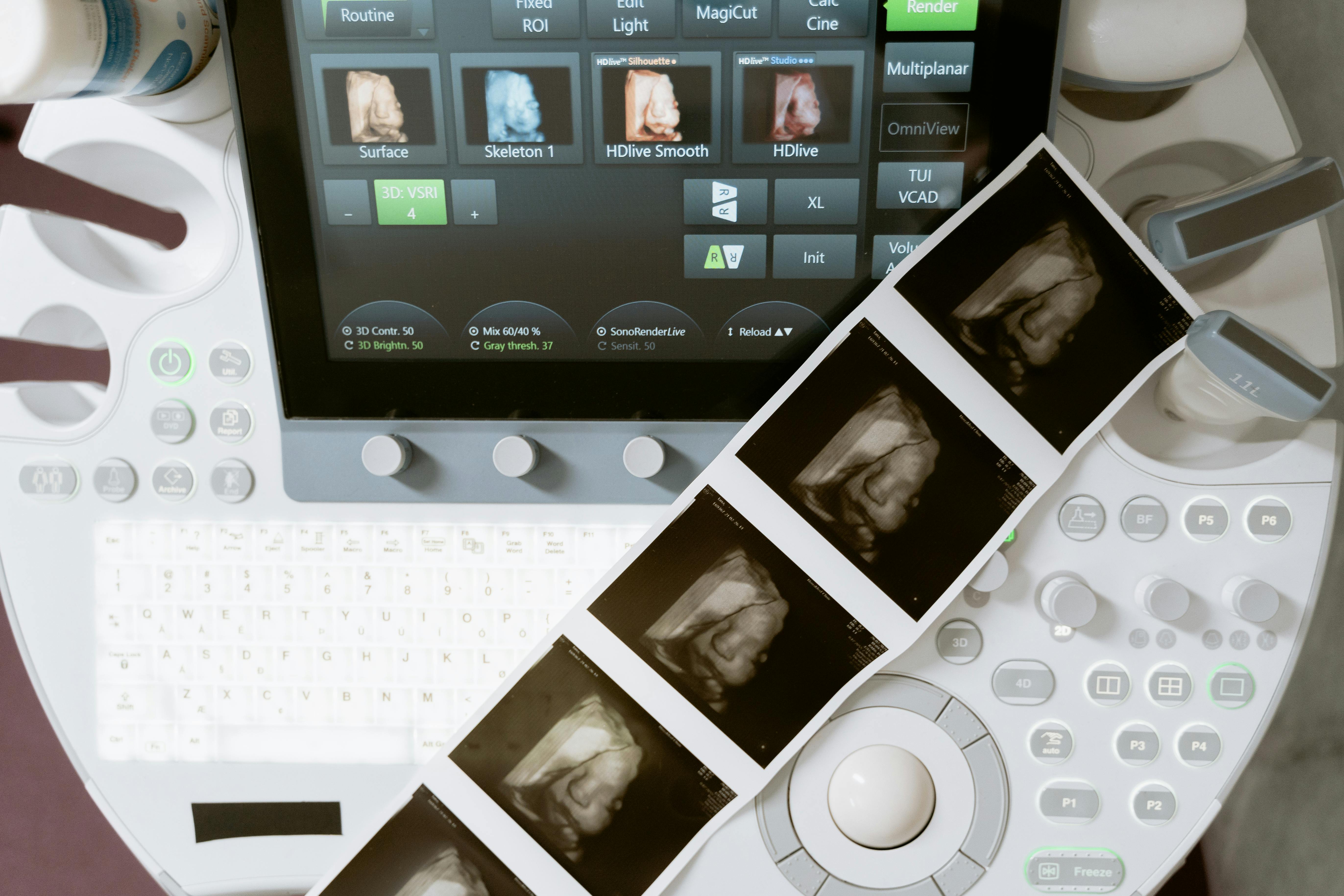
A 4D ultrasound machine for a New Hampshire keepsake studio should be evaluated on rendering quality, workflow efficiency, and reliability under regular client-facing conditions.
What Image Quality Means for New Hampshire Studios
Image quality is the central value proposition of a keepsake studio, and in New Hampshire’s financially capable market it is particularly consequential. Families in Nashua, Salem, and the surrounding Southern Tier communities are accustomed to quality across service categories — they have the means to be selective and the inclination to share their experiences through community networks, school groups, and social media. Images from your sessions will be the primary evidence on which prospective clients evaluate whether your studio is worth booking.
- 3D surface rendering quality: Facial detail and skin texture in static 3D images are the most shared format. In New England’s active parenting communities, strong 3D renders generate organic referrals through exactly the networks that matter most.
- 4D live frame rate: Higher frame rates produce fluid, emotionally impactful fetal movement during live viewing — the in-room experience that families describe to friends and share on social media.
- HD imaging capability: In New Hampshire’s high-income Southern Tier, HD capability supports premium pricing and represents the quality standard that well-researched clients increasingly expect.
- Performance across gestational ages: Reliable imaging at 15 weeks (gender determination), 28–32 weeks (optimal 3D), and 34+ weeks is essential for a complete New Hampshire service menu.
Key Features to Evaluate
| Feature | Why It Matters for New Hampshire Studios |
|---|---|
| Convex 3D/4D probe | Essential — the most critical component for elective scanning quality and longevity |
| Digital image and video output | New Hampshire clients expect USB or cloud digital deliverables as standard |
| Live streaming capability | New England families are often spread across the region and beyond — live streaming for Massachusetts relatives is a genuine differentiator |
| HD imaging support | NH Southern Tier households have Boston-metro incomes and expectations — HD capability supports premium positioning |
| Image optimization controls | Quick real-time adjustment during live sessions is essential for consistent image quality |
| Software support status | Machines without active manufacturer software support have a shortening practical lifespan — always confirm before purchasing |
New vs. Used Machines
New machines offer current software, warranty coverage, known condition, and access to post-sale service. In New Hampshire’s quality-conscious market — where clients are selective and machine downtime costs both revenue and reputation — the assurance that comes with a new machine has real business value.
Used machines can reduce upfront costs meaningfully but require careful due diligence. Probe condition, software version support, documented usage history, and service availability all affect how reliably a used machine serves you over time. Learn more about buying and selling ultrasound equipment.

In New Hampshire’s Southern Tier, equipment quality is a direct positioning signal — the basis on which quality-conscious clients evaluate whether a studio belongs in the premium tier.
Understanding Total Cost of Ownership
A complete New Hampshire studio equipment budget should include all components:
- Ultrasound machine and convex probe
- Large display TV or projector and mount (55″ to 70″ flat panel is the current professional standard)
- Thermal printer
- Computer or tablet for digital delivery and booking
- Video cables, connectors, and live streaming hardware
- Uninterrupted power supply (UPS)
- Gel warmer, spa towels, and client comfort supplies
- Heartbeat animal recording equipment if offering that service
Building a complete budget before committing to a purchase prevents the most common post-launch surprise for new studio owners. If startup capital is a constraint, equipment financing options may help bridge the gap.
Questions to Ask Before You Buy
- What warranty is included, and what specifically does it cover?
- What is the probe warranty, and what does probe replacement cost?
- Is the current software version actively supported by the manufacturer?
- What phone or remote support is available after purchase?
- Does this machine support early gender determination at 15 to 16 weeks?
- Does it support live streaming output?
- Does it support HD imaging mode?
- If used: what is the documented usage history and probe condition?
Equipment Context for Nashua and Salem
Nashua and Salem occupy a specific and strategically important position in the New Hampshire market — they are the Southern Tier cities closest to the Massachusetts border, and their household income profiles reflect their deep integration with the Boston metro economy.
Nashua is New Hampshire’s second-largest city, with a population approaching 90,000 and a household income profile that consistently ranks among the highest in the state. The city has attracted significant technology, insurance, and professional services employment over the past two decades — building a professional workforce with Boston-caliber earnings but New Hampshire’s lower cost of living. In this market, HD imaging is not optional for premium positioning; it is what the client base expects based on what they have seen in comparable markets. A Nashua studio with HD capability can sustain the pricing that the city’s professional household incomes will support.
Salem — on the Massachusetts border at I-93 — is a smaller community with an outsized strategic position. Its location makes it equally accessible to southern New Hampshire families and to a large segment of the northern Massachusetts population in communities like Methuen, Lawrence, and Haverhill that are already oriented toward New Hampshire for services and shopping. A Salem studio effectively operates a bi-state catchment that is significantly larger than Salem’s own population would suggest.
Both markets support HD imaging investment. Both markets also benefit from live streaming capability — given the high concentration of transplanted professionals from across New England and beyond who have relatives in other states wanting to watch sessions remotely. Visit the elective ultrasound machines page to compare current options.
Frequently Asked Questions
How much does a 4D ultrasound machine cost for a New Hampshire studio?
Pricing varies significantly by brand, model, age, and condition. Contact Ultrasound Trainers for current guidance based on your New Hampshire market and budget goals.
Is HD capability necessary in all New Hampshire markets?
In the Southern Tier — Nashua, Salem, Manchester, and Bedford — yes, HD is the expectation for premium positioning. In smaller New Hampshire markets like Keene or Conway, strong 4D capability may be a sufficient entry point. Market context and intended positioning should drive the decision.
Should equipment and training come from the same source?
There are real advantages to doing so. Training on the machine you own means every instructional hour applies directly to your New Hampshire studio from day one. Ultrasound Trainers offers both as a coordinated offering — eliminating any adaptation gap between training and real-world operation.
Need Help Comparing Equipment?
If you are comparing 4D ultrasound machines for a New Hampshire keepsake studio — in Nashua, Salem, or anywhere across the state — Ultrasound Trainers can help you evaluate options and match equipment to your specific market and business goals.
Contact Ultrasound Trainers to discuss your equipment questions.
About This Content: Ultrasound Trainers is a Nashville, Tennessee-based company specializing in elective ultrasound training, turnkey studio startup packages, and equipment guidance for people opening keepsake ultrasound businesses across the United States. This content is for informational purposes and does not constitute medical, legal, or financial advice. Last Updated: April 2026.
Get the Inside Track
Training tips, business advice, and exclusive deals delivered straight to your inbox.

How to Get More Bookings for Your Elective Ultrasound Studio in Montana
Struggling to fill your elective ultrasound booking calendar in Montana? This guide covers what actually[...]

Buying an Elective Ultrasound Machine for an Arkansas Studio: What Actually Matters
Ready to buy an elective ultrasound machine for your Arkansas studio? This guide covers the[...]

How to Build a Pre-Launch Marketing Campaign for Your Elective Ultrasound Studio: A 60-Day Countdown Plan
Pre-launch marketing for an elective ultrasound studio begins 60 days before opening. This 60-day countdown[...]

What Career Changers in Hawaii Need to Know About Elective Ultrasound Training
Considering ultrasound training for a career change in Hawaii? This Q&A guide covers what training[...]

How to Find and Recruit Volunteer Scan Models for Elective Ultrasound Practice
Finding volunteer models for elective ultrasound practice is a skill in itself. Learn where to[...]

How to Write an Elective Ultrasound Business Plan That Actually Works
Writing an elective ultrasound business plan? This guide covers what to include, how to build[...]

How to Open an Elective Ultrasound Business in Honolulu: A Practical Startup Guide
Open an elective ultrasound business in Honolulu with confidence. This guide covers training, startup costs,[...]

Adding Elective Ultrasound to an Existing Photography or Doula Practice in Montana
Montana birth photographers and doulas: adding an elective ultrasound add-on business in Montana to your[...]

Starting an Elective Ultrasound Business in Cheyenne, Wyoming: First-Mover Advantage in the Least-Crowded Market in the Country
Thinking about starting an elective ultrasound business in Cheyenne, Wyoming? This guide covers the F.E.[...]

Elective Ultrasound Training for Career Changers in Sweden
Considering a career change into elective ultrasound in Sweden? Find out what training involves, whether[...]

What Career Changers in Fayetteville Should Know About Elective Ultrasound Training
Thinking about elective ultrasound training in Fayetteville, Arkansas as a career changer? This Q&A guide[...]

The Biggest Mistake Las Vegas Elective Ultrasound Studios Make With Their Marketing
Elective ultrasound studio marketing in Las Vegas prioritizes trust and reviews over ad spend. Here's[...]
