

Picture this: you have been working as a birth photographer for three years. You are in the room for gender reveals, you are capturing the moments when families find out whether they are having a boy or a girl, and at some point you start wondering — could I be the one running that service instead of just documenting it? Could a gender scan be something my business offers rather than something I refer clients to?
It is a question we hear from photographers and doulas regularly. And the answer, more often than not, is yes — with the right training.
Gender determination is one of the most-requested elective ultrasound services in the industry. Families want to know as early as possible, and an elective studio that offers accurate early gender scans can become the go-to service in a local market quickly. But the skill itself is not as simple as pointing a probe and reading a result. It requires specific training, an understanding of gestational timing, and a clear approach to communicating limitations honestly with clients.
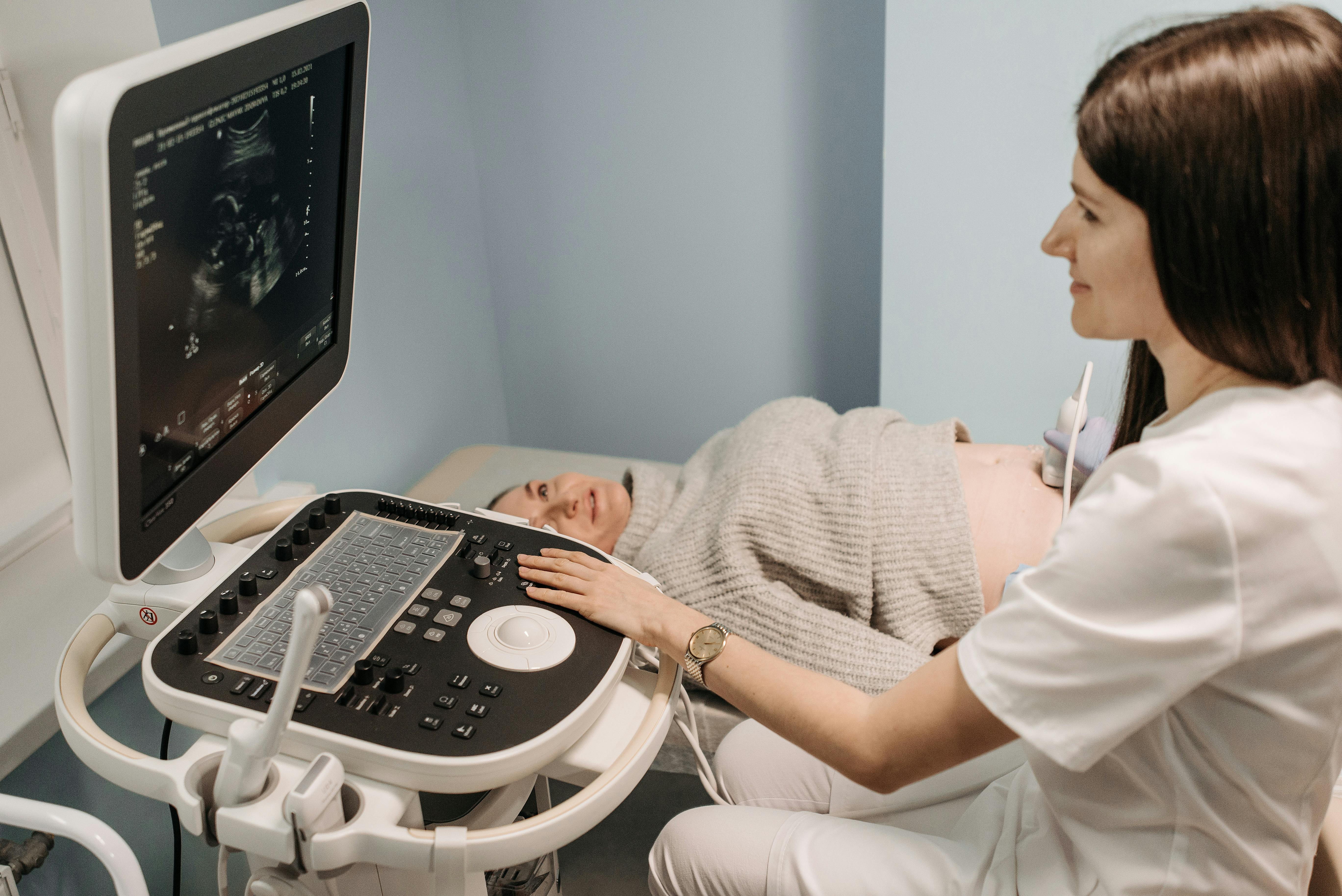
This post is for people who are exploring elective ultrasound training and want to understand specifically what gender determination training involves, what it teaches, when gender scans can be reliably performed, and what clients need to understand going into that kind of session. Whether you are a career changer investigating this as a new business, a doula looking to expand your services, or someone in the middle of evaluating training programs, here is what the skill actually looks like in practice.
Why Gender Determination Is Its Own Training Skill
The anatomy that determines fetal sex is visible on ultrasound, but the clarity and reliability of that image changes significantly depending on gestational age, fetal position, amniotic fluid level, and operator technique. At 15 or 16 weeks — the window that early gender scan services typically target — the structures are present but smaller and more subject to position variability than they are at 20 weeks. A technician who does not have specific training in early gender determination will miss correct positioning, misread ambiguous images, or simply not know how to communicate uncertainty to a client in a way that manages expectations fairly.
That is why studios that train on gender determination spend dedicated time on the anatomy itself, on the characteristic views that indicate sex, on how to recognize when a result is clear versus when it is not, and on how to handle sessions where a definitive call cannot be made. Getting it right most of the time is not good enough in a business context. Your reputation depends on how you handle the sessions where the image is ambiguous.
What Early Gender Determination Training Covers
Good elective ultrasound gender determination training covers the anatomy first. Trainees learn the structures they are looking for in male and female fetuses at the gestational ages relevant to early gender scans — typically 15 to 16 weeks. They learn what those structures look like on screen, what views to capture, and what typical and atypical presentations look like.
From there, training moves into scanning technique specifically for this service. The probe positioning, the angle adjustments, the way fluid levels and fetal position affect visibility — all of this is part of what a trained technician needs to be able to navigate in real time. A live training session using actual clients or phantoms is especially valuable here, because the skill of adjusting in response to what you see on screen is something that only develops through hands-on practice.
Training also covers how to talk to clients. This matters more for gender determination than almost any other elective service, because client expectations are high and the emotional stakes of getting it wrong are real. A well-trained technician knows how to communicate a confident result when they have one, how to explain when conditions are not ideal, and how to handle a rebooking gracefully when a session cannot produce a clear image.
How Early Can Gender Be Determined Reliably?
This is one of the most common questions studio owners and their clients both have. The honest answer is that accuracy improves with gestational age, but experienced technicians trained specifically in early determination can often achieve reliable results starting around 15 to 16 weeks.
Before 15 weeks, the accuracy of gender determination drops considerably even for skilled operators, because the anatomical differentiation is still developing. After 18 to 20 weeks, results become much more consistently clear — which is why standard prenatal anatomy scans are scheduled in that range. The 15 to 16-week window is the early sweet spot that elective studios can serve, with the caveat that results at this stage are less guaranteed than later in the pregnancy.
Communicating this to clients is part of running a professional early gender scan service. Families who understand that the service offers a best attempt rather than a guaranteed result — and who know that a rebooking is available if needed — are much better positioned to have a positive experience regardless of outcome.
Adding Gender Determination to Your Service Menu
From a business standpoint, early gender scan services are often one of the highest-demand offerings an elective studio can provide. Many families are looking for a way to find out the sex of their baby before the standard 20-week anatomy scan, and an elective studio that offers a reliable, warm, and professionally run gender reveal service fills that gap in a way the medical system does not.
The revenue profile is also attractive. Gender determination scans are typically shorter sessions — often 15 to 20 minutes — which means they can be slotted into a schedule more efficiently than a full bonding scan. If your studio is also offering gender reveal accessories like color reveal gender bands, the average ticket for this service type can grow meaningfully beyond the scan price alone.
Doulas and birth photographers who add this service to their existing business often find that it integrates naturally with their current client base. Families who are already in their care during pregnancy are often the same families who want an early gender reveal experience. The addition feels like a natural expansion of the relationship rather than a separate service line.
How to Approach Learning This Skill
If you are evaluating elective ultrasound training programs with gender determination as a priority, look specifically for programs that include this component as a named part of the curriculum. Not every training program covers early gender determination at the 15 to 16-week window — some programs focus primarily on late-pregnancy 3D and 4D bonding scans and treat gender as secondary.
Hands-on training is particularly important for this skill. Reading about the anatomy and watching video examples is a useful starting point, but the real learning happens when you are holding the probe and adjusting in response to what you see on screen. If the program you are considering does not include hands-on practice with real clients or realistic training phantoms, ask specifically what replaces that experience and how graduates develop confidence in live sessions before they start seeing paying clients.
What Your Clients Need to Understand About Gender Scans
Running an early gender determination service responsibly means setting expectations clearly from the booking stage forward. Your website, your intake process, and your session communication should all convey that early gender scans provide a high-confidence attempt at determining sex based on the images available on that day — not a medical guarantee.
Clients need to understand that fetal position and gestational timing affect whether a clear result is possible, that you may need to rebook if conditions are not ideal, and that your service is not a substitute for the anatomy scan they will receive through their medical provider. That positioning protects you legally and professionally, and it also sets a client expectation that is easier to deliver on consistently.
- State clearly on your booking page that early gender determination accuracy depends on fetal position, gestational age, and imaging conditions
- Offer a rebooking policy for sessions where a clear image cannot be obtained
- Train yourself on how to communicate uncertainty during a session without creating anxiety
- Always direct clients to confirm with their OB or midwife if they want medical certainty about the sex of their baby
- Document your session disclosures so clients understand what the service is and is not before they arrive
You are offering a meaningful, emotionally resonant experience. The families who come to you for an early gender reveal are often excited, emotional, and looking forward to a memorable moment. When you deliver that experience professionally and honestly, the impact is significant — and the word of mouth that follows is one of the most powerful marketing tools your studio can have.
FAQ: Elective Ultrasound Gender Determination Training
No. Some programs focus primarily on 3D and 4D bonding scans at later gestational ages and cover gender determination only briefly or not at all. If early gender scans are a priority for your business model, ask specifically whether the training program covers early gender determination at 15 to 16 weeks and what the hands-on component includes for that skill.
Accuracy at 15 to 16 weeks depends heavily on fetal position, the technician’s experience, and the machine being used. Experienced and well-trained technicians can achieve strong accuracy rates at this gestational age, but results are less consistent than at 20 weeks or later. Being transparent with clients about this variability is a key part of running the service professionally.
No. The elective ultrasound industry includes many successful studio owners who came in from non-medical backgrounds — career changers, photographers, doulas, and entrepreneurs — and who learned gender determination as part of their training. The skill is learnable with proper instruction and practice. What matters is the quality of the training and the commitment to hands-on practice afterward.
Have a clear rebooking policy established before you open. When a session does not produce a clear result, communicate calmly and matter-of-factly that conditions were not ideal and offer to reschedule at no charge. Clients who understand this possibility from the start generally handle it well. Studios that do not set this expectation upfront are the ones who face frustrated clients when it happens.
Yes. Many studios offer gender reveal packages — including gender bands, balloons, or other reveal accessories — alongside the scan service. The key is to structure the package so the reveal experience is conditional on a clear scan result, and to communicate that clearly at booking. A client who understands the process will still have a meaningful experience even if the reveal is delayed to a follow-up session.
Interested in Training That Includes Gender Determination?
Ultrasound Trainers’ training program includes early gender determination training at 15 to 16 weeks as part of the hands-on curriculum. If you are evaluating training programs and want to understand what the full training experience covers, explore elective 3D/4D ultrasound training with Ultrasound Trainers, or reach out to the team directly to talk through what the program includes and whether it is the right fit for your goals.
This post was written by the team at Ultrasound Trainers, a company that trains and supports people opening elective keepsake ultrasound studios. Our curriculum includes hands-on training for early gender determination, 3D and 4D scanning, advanced techniques, and business development. Content is written for business-minded operators, not expecting parents.
Get the Inside Track
Training tips, business advice, and exclusive deals delivered straight to your inbox.

How to Get More Bookings for Your Elective Ultrasound Studio in Montana
Struggling to fill your elective ultrasound booking calendar in Montana? This guide covers what actually[...]

Buying an Elective Ultrasound Machine for an Arkansas Studio: What Actually Matters
Ready to buy an elective ultrasound machine for your Arkansas studio? This guide covers the[...]

How to Build a Pre-Launch Marketing Campaign for Your Elective Ultrasound Studio: A 60-Day Countdown Plan
Pre-launch marketing for an elective ultrasound studio begins 60 days before opening. This 60-day countdown[...]

What Career Changers in Hawaii Need to Know About Elective Ultrasound Training
Considering ultrasound training for a career change in Hawaii? This Q&A guide covers what training[...]

How to Find and Recruit Volunteer Scan Models for Elective Ultrasound Practice
Finding volunteer models for elective ultrasound practice is a skill in itself. Learn where to[...]

How to Write an Elective Ultrasound Business Plan That Actually Works
Writing an elective ultrasound business plan? This guide covers what to include, how to build[...]

How to Open an Elective Ultrasound Business in Honolulu: A Practical Startup Guide
Open an elective ultrasound business in Honolulu with confidence. This guide covers training, startup costs,[...]

Adding Elective Ultrasound to an Existing Photography or Doula Practice in Montana
Montana birth photographers and doulas: adding an elective ultrasound add-on business in Montana to your[...]

Starting an Elective Ultrasound Business in Cheyenne, Wyoming: First-Mover Advantage in the Least-Crowded Market in the Country
Thinking about starting an elective ultrasound business in Cheyenne, Wyoming? This guide covers the F.E.[...]

Elective Ultrasound Training for Career Changers in Sweden
Considering a career change into elective ultrasound in Sweden? Find out what training involves, whether[...]

What Career Changers in Fayetteville Should Know About Elective Ultrasound Training
Thinking about elective ultrasound training in Fayetteville, Arkansas as a career changer? This Q&A guide[...]

The Biggest Mistake Las Vegas Elective Ultrasound Studios Make With Their Marketing
Elective ultrasound studio marketing in Las Vegas prioritizes trust and reviews over ad spend. Here's[...]
Explore all training formats, durations, and programs in our complete elective ultrasound training guide.
